What is abstract reasoning?
Abstract reasoning involves identifying rules among shapes, symbols and arrangements, then predicting a missing element by checking the features and transformations supplied in the question.
The worked questions cover a specified rotation, interleaved sequences, a row-combination matrix, reflection rather than rotation, exclusive combination and a two-dimensional check. Use the explained answers to check your method, then practise applying the same principles to fresh facts instead of memorising an answer sequence.
Why this skill matters
Visual rules can combine independent constraints. A tile may need the correct shape, colour and orientation simultaneously, so matching a single feature is insufficient. Distinguishing rotation, reflection and combination rules helps you test a candidate systematically. The six original diagrams below show these operations directly. Each question also includes a written description and labelled options so you can check the rule without relying on colour alone. These introductory illustrations support practice; they do not reproduce every perceptual demand of a complex visual assessment.
A subject-specific method
Step 1
List shape, count, colour, size, position and orientation separately before proposing a combined rule for the missing frame.
Step 2
Describe rotation direction and angle explicitly; a reflection is a different transformation even when one symbol looks similar.
Step 3
Test the proposed relationship on every complete row or transition, rather than relying only on the last visible pair.
Step 4
Eliminate an answer only for a stated inconsistency, and check that the surviving option satisfies every independent feature rule.
Step 5
Explain the transformation in words after solving, then apply it to a fresh arrangement instead of memorising the pictured tile.
Original worked scenario
Scenario: The sequence is circle → square → circle → square → ?. The question mark is the fifth and final position; shape alternation is the only changing feature.
Task: Choose the fifth shape: A, circle; B, square; or C, triangle.
Worked answer: A, circle. The specified alternation returns to a circle after the fourth-position square.
Why this works: The alternating rule predicts a circle after the final square. That conclusion uses the specified shape sequence only. In a different question, additional visual features could impose further constraints. Check any colour, position or orientation information actually supplied; do not invent extra conditions for this introductory sequence.
Common trap: Do not assume the first pattern noticed is the only pattern.
How to prepare effectively
Practise one transformation at a time before combining features. For rotation, track an arrow through a full cycle and name the direction of each turn. For reflection, describe which positions change and which stay fixed. For count rules, make a small table of quantities across frames. This separate practice gives you a vocabulary for explaining why an answer fits, rather than simply saying that it looks right.
Next, combine two independent features, such as count increasing while colour alternates. Predict both features before examining the options. If you choose an option because its shape matches, check colour, position and orientation deliberately before finalising. A short verification pass is often more useful than trying several complicated rules after becoming attached to the first guess.
Use text descriptions as a learning aid, but include appropriate visual material in preparation for a visual assessment. Notice whether your errors arise from misunderstanding a transformation or from overlooking a small visual difference. Those problems need different practice: explaining a reflection helps the first, while systematic feature scanning helps the second. Do not infer a diagnosis about your general ability from one format.
For review, write the proposed rule, the evidence supporting it and the feature that defeated the wrong option. If several rules remain plausible, identify what the instructions or options contribute. The examples in this guide specify their transformations where needed so that the answer is defensible. When creating your own exercises, do the same rather than presenting an ambiguous pattern as if only one continuation were mathematically possible.
Mistakes that reduce scores
Watch for a candidate tile that satisfies only one feature. A correct count can conceal the wrong colour, and a correct orientation can conceal the wrong position. Also distinguish reflection from rotation and a union from a cancellation rule. Check the full proposed transformation before accepting a visually familiar answer.
Frequently asked questions
How do rotation and reflection differ?
Rotation turns a figure through an angle. Reflection reverses it across a line. Track positions and orientation to distinguish the operations.
Why check every row of a matrix?
A plausible rule should fit all complete information. Matching one row alone can support an accidental pattern that fails elsewhere.
Are text examples enough for a visual test?
Written descriptions help explain the transformations. Use the diagrams and labelled options in this guide too, then practise with the visual formats specified by your assessment provider.
Does Talentrenza list a separate Abstract Reasoning assessment?
The observed catalogue does not. This guide labels Logical Reasoning as related preparation and does not invent a standalone product route.
Abstract reasoning: track features and transformations
Abstract reasoning asks you to infer relationships among shapes, symbols or arrangements. A useful first pass separates shape, count, position, orientation, colour and size. A sequence may change one feature while holding the others constant. A matrix may apply one rule across rows and another down columns. Treat each feature as a candidate variable rather than trying to understand the entire picture in one glance.
State a proposed rule precisely enough to predict the missing item. Shapes rotate is incomplete; the arrow rotates 90 degrees clockwise at each step is testable. Check that prediction against every supplied frame. If a rule explains only the last transition, it may be an attractive coincidence rather than the intended relationship.
Each exercise below includes an original diagram, labelled answer options and a complete written description. Try the question before reading the answer. The images make the visual task explicit; the descriptions explain the same facts for readers using assistive technology or unable to view an image. Practise more complex formats separately if your assessment requires them. Abstract Reasoning is not currently a separate production catalogue entry; any Logical Reasoning link is a related skill, not a claim that the platform offers an identical visual test.
Question 1: A specified rotation
An arrow points up, right, down and left in successive frames. The stated rule is a 90-degree clockwise rotation at every step, with no other feature changing. Which direction comes next?
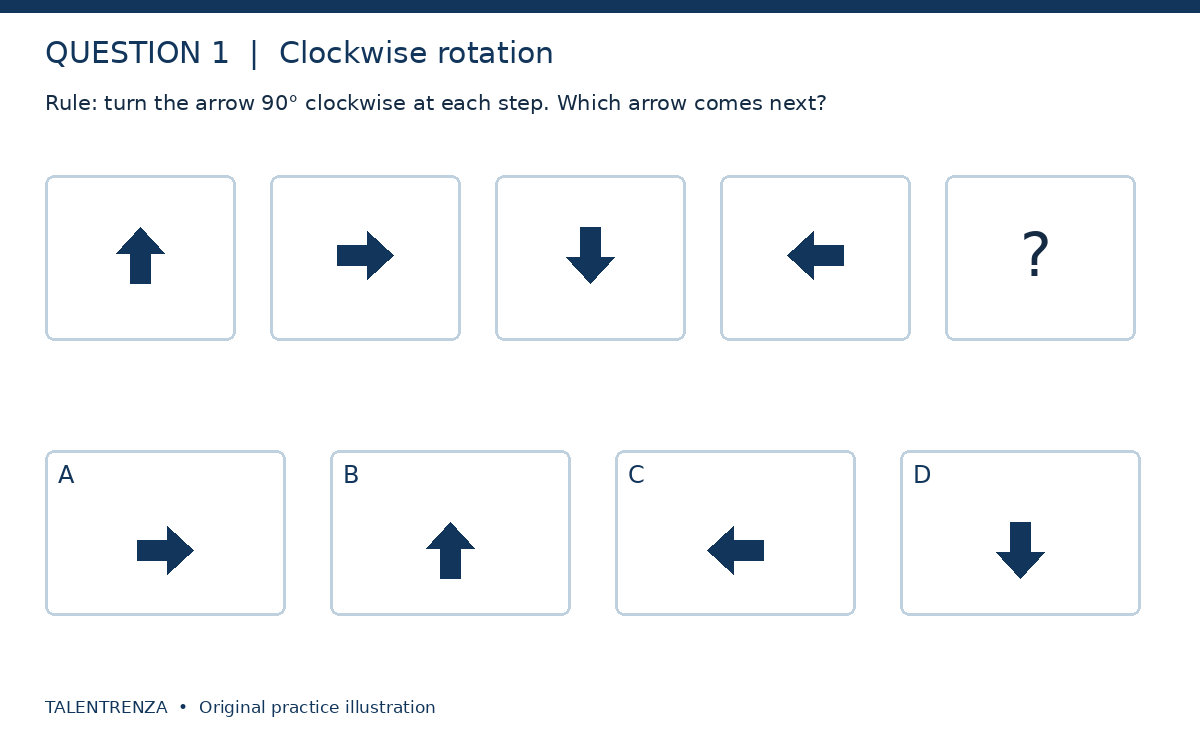
Options: A, right; B, up; C, left; D, down.
Answer: B, up. Four quarter-turns complete one revolution. Follow the orientation through the entire cycle rather than reversing direction at the last frame. A left-pointing arrow followed by an up-pointing arrow is consistent with the clockwise rule. If the sequence had also changed position or colour, those features would need separate checking. A correct orientation alone would not necessarily identify the correct answer tile.
Question 2: Interleaved sequences
Tiles show one black circle, two white circles, three black circles, four white circles and five black circles. The count increases by one while colour alternates. Describe the sixth tile.
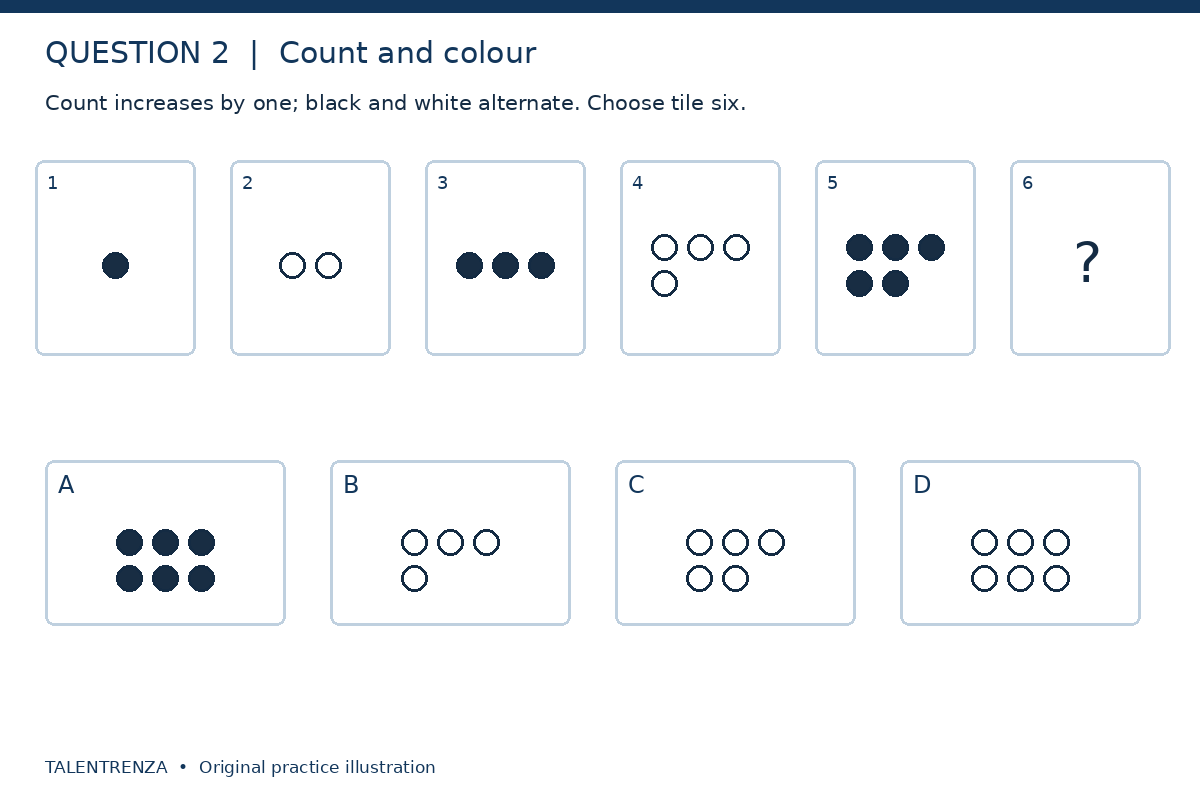
Options: A, six black circles; B, four white circles; C, five white circles; D, six white circles.
Answer: D, six white circles. The number rule and colour rule must both be satisfied. Six black circles follow the count but violate the alternation; four white circles follow the expected colour but violate the count. This illustrates why answer elimination should compare more than one feature. Once you have a candidate, perform a final check against all stated rules instead of stopping when one familiar element looks right.
Question 3: A row-combination matrix
In each row, the third box contains the total number of dots in the first two boxes. Row one contains 2, 3 and 5 dots; row two contains 4, 1 and 5 dots. Row three begins with 3 and 6 dots. How many dots belong in its third box?
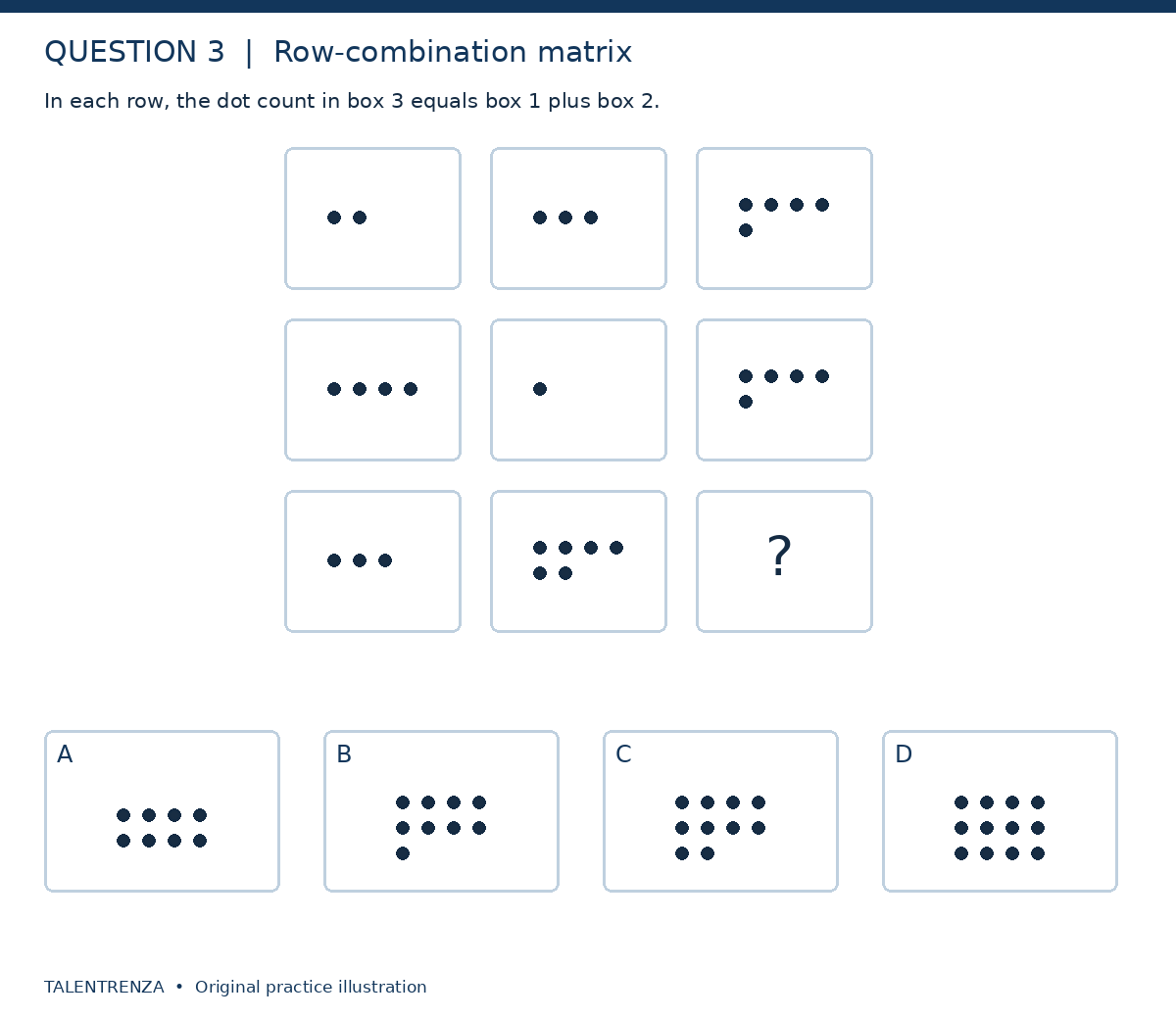
Options: A, eight dots; B, nine dots; C, ten dots; D, twelve dots.
Answer: B, nine dots, because 3 plus 6 equals 9. Both complete rows support the stated addition rule. Subtraction would not fit them consistently. In a visual matrix, distinguish counting separate dots from combining overlapping shapes; the rule depends on the representation. Here the numbers explicitly describe counts and addition is specified, so no assumption about visual overlap is required. Test the rule on the complete rows before extending it.
Question 4: Reflection rather than rotation
A two-by-two grid has a dot in its upper-left cell and a right-pointing triangle in its lower-left cell; both right-hand cells are empty. Reflect the entire grid across a vertical centre line. Where do the symbols go, and which way does the triangle point?
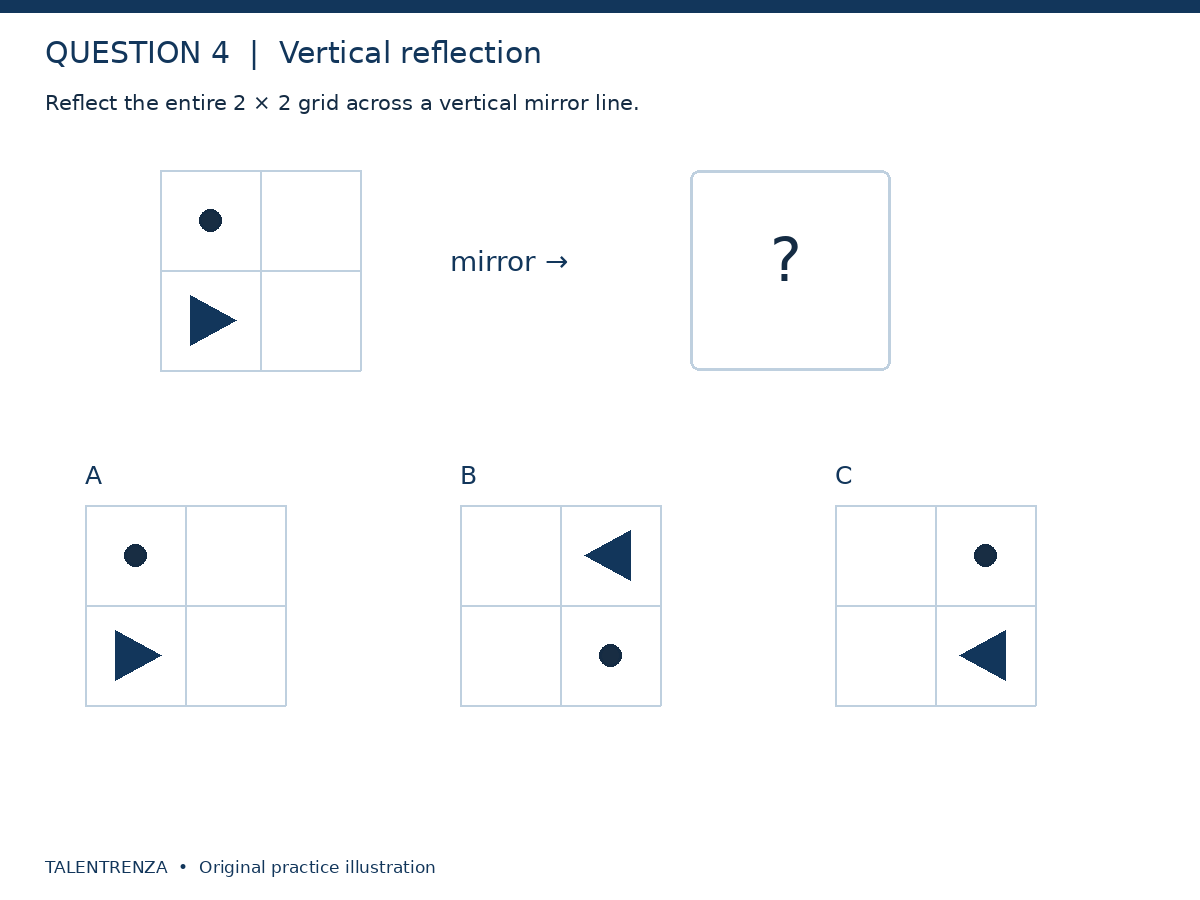
Options: A, the original grid unchanged; B, left-pointing triangle upper-right and dot lower-right; C, dot upper-right and left-pointing triangle lower-right.
Answer: C. The dot moves to the upper-right cell and the triangle moves to the lower-right cell and points left. Reflection mirrors the triangle itself as well as its position. Their vertical positions remain the same. A 180-degree rotation would also exchange top and bottom, so it is a different transformation. A useful check is to ask which coordinate changes under the operation. Reflection across a vertical line changes left and right; it does not exchange the top and bottom rows in this scenario.
Question 5: Exclusive combination
Two boxes contain symbols selected from a circle, square and triangle. A result box keeps symbols appearing in exactly one input box and removes symbols appearing in both. Input one contains a circle and square; input two contains a square and triangle. What remains?
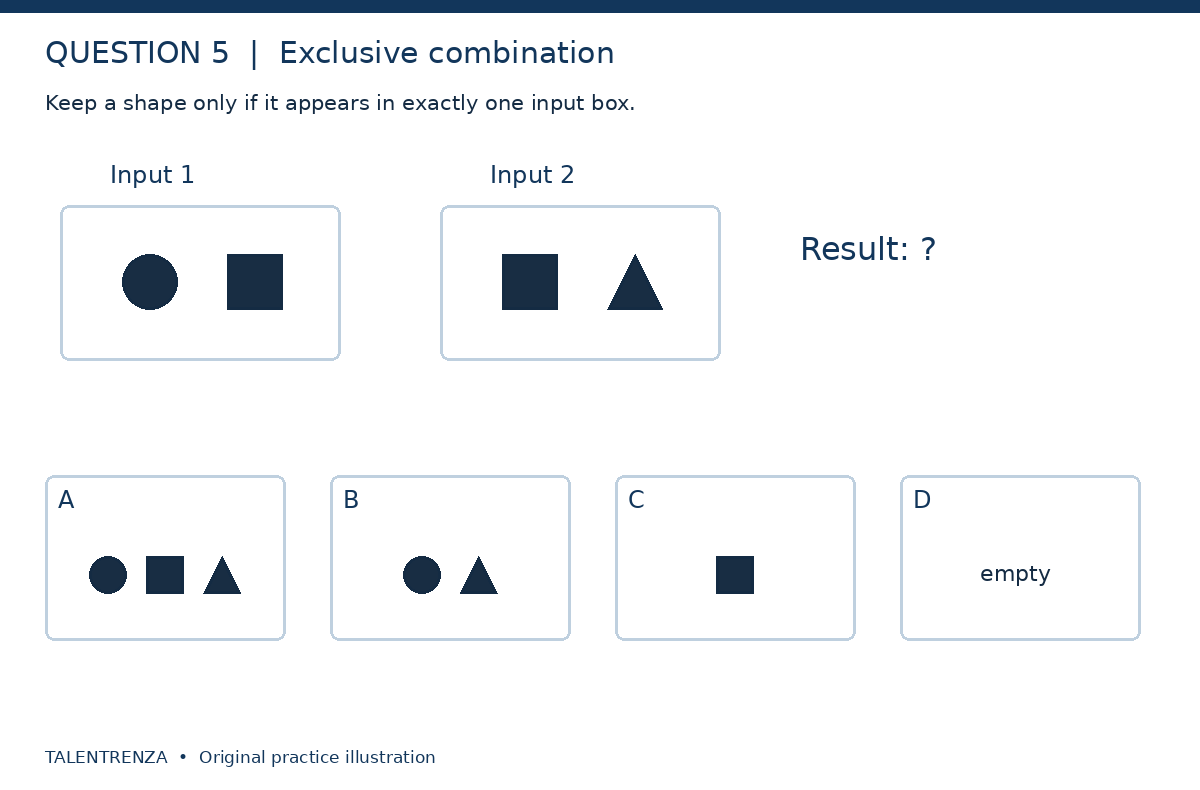
Options: A, circle, square and triangle; B, circle and triangle; C, square only; D, no shapes.
Answer: B, a circle and triangle. The square appears in both inputs and is removed. A union rule would retain all three symbols, while an intersection rule would retain only the square. The task explicitly defines the combination operation, so choose the result for that operation. Do not use everyday ideas of addition when a diagram defines cancellation or another transformation. Naming the rule helps prevent that confusion.
Question 6: A two-dimensional check
A three-by-three matrix follows two rules. Each row contains one circle, one square and one triangle. Each column contains one black, one grey and one white symbol. In the final row, a square and triangle are already present. In the final column, black and grey symbols are already present. What must fill their shared missing cell?
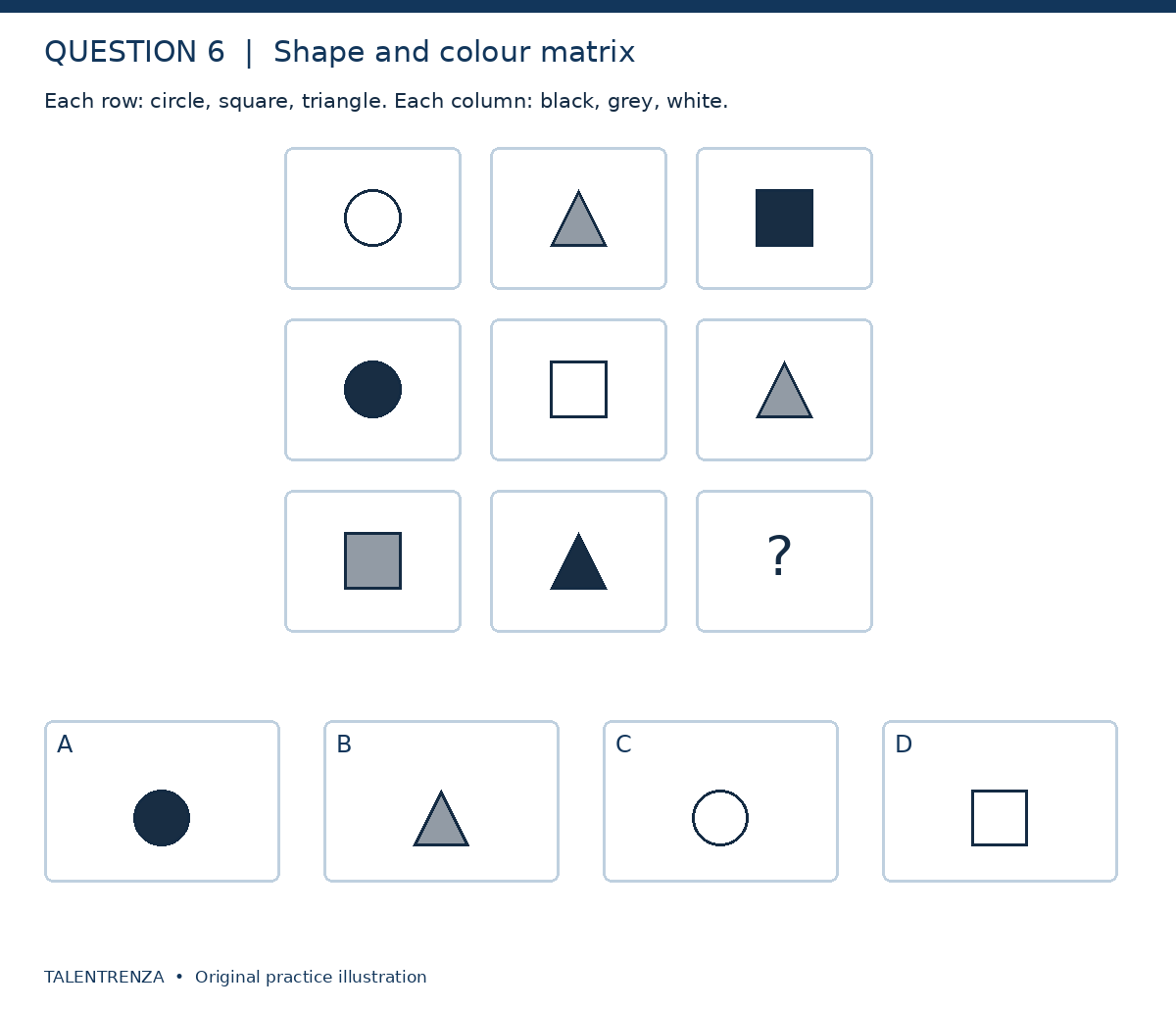
Options: A, black circle; B, grey triangle; C, white circle; D, white square.
Answer: C, a white circle. The row determines shape and the column determines colour. A black circle satisfies the shape rule but breaks the column rule; a white square satisfies colour but breaks the row rule. This is a good example of combining independent constraints. The answer follows the explicit rules, without requiring assumptions about the order of shapes in the other cells.
How to practise visual rules deliberately
Create an error log by feature: missed count, wrong rotation direction, confused reflection, overlooked colour or assumed combination rule. Reconstruct a missed item in a simpler form and explain the transformation in words. Then try a different example using the same operation. Remembering the correct tile is less useful than recognising which feature and transformation you missed.
Avoid adding increasingly complicated rules to rescue an early guess. Prefer a consistent explanation supported by the complete information and the task's conventions. Finite patterns can admit multiple constructed continuations, so the answer options and instructions matter. If you are creating practice questions yourself, specify enough structure for the intended answer to be defensible, as these examples do. Do not mistake a vague prompt with several possible answers for a difficult but well-defined assessment item.
Explore a related assessment
Talentrenza currently lists Logical Reasoning as a related skill. This guide does not imply that a separate Abstract Reasoning assessment is available. Review the destination page and its current access terms before registering or using credits.